We have now reached the final blog of the NGS-Solutions for Clinical Variant Analysis series. Part I of this series explored the capture of variant classifications in the VSClinical environment when following the ACMG and AMP guidelines. Part II was similar in content but for the capture of clinically relevant copy number variants as well as using a CNV catalog… Read more »
In the first two parts of this blog, we presented examples of how to leverage Warehouse-stored VSClinical and CNV assessment catalogs in the VarSeq project. Now we are going to explore the Warehouse interface a bit more and show how to query on stored variant data. To access Warehouse from VarSeq, click the V Connect icon located in the top… Read more »
Part 1 of this blog series was focused on new capabilities in Warehouse to store your CNV results. We explored some approaches of how to utilize assessment catalogs of cohort and known pathogenic events. What makes Warehouse so useful in this application is that the catalog is accessed from one central location and ensures every user is leveraging the same… Read more »
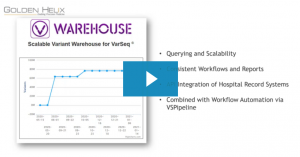
We recently hosted a webcast covering the value and application of VSWarehouse through VarSeq. Not only is VSWarehouse a solution for storing your NGS data in a central repository, but it also provides a means to enhance the tertiary analysis done in VarSeq. VSWarehouse will store all your sample/variant data but also stores your catalogs of pathogenic variants, clinical reports, and has the capability of filtering/querying on all your stored data quickly. In addition,… Read more »
This webcast generated some great questions! If you have any other questions for me that are not answered below, please feel free to ask those by emailing [email protected]. To what level does the Warehouse scale? We have tested multiple instances of Warehouse in-house and on the cloud and it scales incredibly well to tens of thousands of samples and 100s… Read more »
With the recent release of VarSeq 1.4.7, we have expanded the concepts of our popular assessment catalog to include CNV and other region-based records and not just variants. To match these capabilities, we have made a major update to VSWarehouse that supports these new record types in the centrally hosted and versioned Catalogs and Reports. Review of the VSWarehouse Genomic… Read more »
The new VSWarehouse Tutorial covers the basic VSWarehouse workflow.This tutorial focuses on connecting to a VSWarehouse instance from VarSeq, adding an existing VSWarehouse project as an annotation source and using reports and assessment catalogs hosted on VSWarehouse. This workflow requires an active VarSeq license with the VSWarehouse feature included. You can go to Discover VarSeq or email [email protected] to request an… Read more »
Wednesday, April 6th 12:00 pm EDT As the number of samples and associated data volume in a testing lab increases, it becomes imperative for labs to leverage state of the art warehousing technology that not only organizes data, but also aides and enables researchers and clinicians to perform further analysis, and ongoing research. Built on the algorithms and high-performance storage… Read more »
Yesterday, it was my pleasure to share in a live webcast our integrated solution for genetic data warehousing, VSWarehouse. Although we had a great set of questions at the end of our presentation, we didn’t have time to answer all of them, so here is a selection of the remaining representative questions and my answers. We can provide a hosted version… Read more »
So, why are we launching a new data warehouse product? Why did we build VSWarehouse? According to Grand View Market Research, the next generation sequencing (NGS) market size was $2.0 billion (USD) globally in 2014. This number is expected to grow from 2015 to 2022 at an annual rate of about 40%. What drives this phenomenon is the increasing number… Read more »
When quality metrics generated during secondary analysis are not incorporated into interpretation and reporting, variants are reported without the important context that could affect confidence in the call. The Golden Helix software suite has been designed to help you bring in quality metrics from secondary analysis through to interpretation and reporting. When using VarSeq, it’s essential to leverage the software’s… Read more »
With our release of VarSeq 3.0.0, we’re excited to highlight one of the most impactful capabilities of our platform: Dx Mode. This program enables VarSeq to be used as a Class A Medical Device, supporting laboratories operating within the European In Vitro Diagnostic Regulation (IVDR). The use of Dx Mode is backed by Golden Helix’s ISO 13485-compliant quality management system…. Read more »
Golden Helix is excited to exhibit at the Association for Molecular Pathology (AMP) 2025 Annual Meeting in Boston, Massachusetts, where we’ll showcase our newest advancements in variant interpretation, enterprise genomics, and scalable software deployment. Visit us at Booth #543 to explore how VSWarehouse and our Bring Your Own Cloud (BYOC) solution enable laboratories to deploy secure, scalable, and compliant cloud-based… Read more »
Recently, Golden Helix attended the ASHG 2025 conference, where we had the opportunity to showcase our partnership with Genomenon. This collaboration took center stage at both our booth and Genomenon’s CoLab session, Automating Genomic Workflows: Cutting Interpretation Time, Accelerating Turnaround, and Increasing Diagnostic Yield. Our discussions centered on a problem that every clinical lab faces as variant volumes continue to… Read more »
Golden Helix is thrilled to announce our participation at the American Society of Human Genetics (ASHG) 2025, where we will be in attendance from October 15-18 in Boston, Massachusetts. Visit us at Booth #1155 for a look at VSWarehouse 3 and our Bring Your Own Cloud (BYOC) solution, enabling secure, scalable cloud deployments. Live Software Demos: Experience Innovation in Action Discover how Enterprise Genomics enhances clinical workflows with seamless… Read more »
We’re thrilled to announce that VarSeq 3.0.0 is right around the corner, and with it comes one of the most exciting updates yet: a complete reimagining of the Assessment Catalogs system. Whether you’re curating clinically relevant variants, tracking tumor-specific calls, or building rich catalogs of sample information, the new system is designed to be more powerful, more versatile, and easier… Read more »
As a new member of Golden Helix’s Field Application Services team, I’ve recently been diving into the capabilities of VarSeq and our broader software suite – an experience every new VarSeq user goes through. If I could schedule a training call with my former self, there are some key points I’d share to help hit the ground running. Here are… Read more »
In the world of genomics, data ownership and portability are fundamental principles that every researcher and clinician should embrace. With the increasing complexity of genomic datasets and the critical importance of long-term data accessibility, having the ability to export your data in multiple formats is not just convenient, it’s essential. This is where the gautil export commands shine, providing researchers… Read more »
Modern genomics workflows often require multiple specialized tools working in concert. In the upcoming VarSeq release, we are excited to announce the option for tighter integration with IGV. Genomics researchers and clinicians are well-versed in using IGV as a visualization tool for their genomic data. This new option will allow for synchronizing the view in the Golden Helix GenomeBrowser with… Read more »
Long-read sequencing technologies have opened new doors in genomics research, enabling more comprehensive analysis of structural variants, phasing, and complex genomic regions. To support these powerful applications, we’ve introduced several new features to GenomeBrowse that specifically enhance the visualization of long-read alignment files. These improvements are designed to help our users extract meaningful insights from their data while minimizing visual… Read more »